Beyond the Tipping Point: A Humane Response
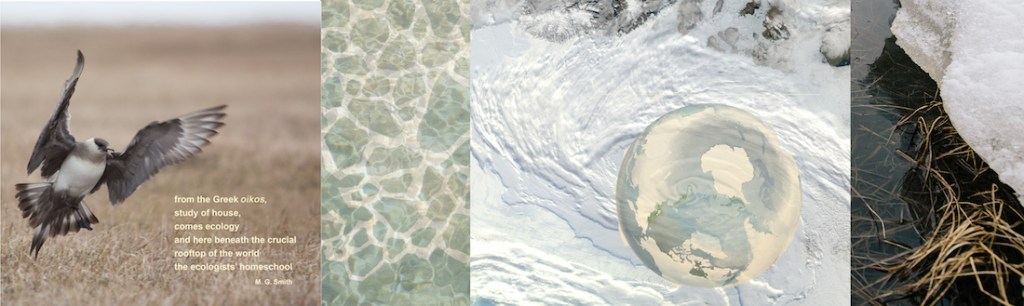
Far from familiarity and experience of the vast majority of Earth’s peoples, the polar regions are changing faster than any other landscape due to anthropogenic climate change. Many of the effects occur on scales too small to be seen by the naked eye, such as the chemistry of a diatom’s thinning silica shell, or too large to comprehend with a single snapshot, such as changing ocean currents and the collapse of tundra biotic communities. Many are too subtle to observe without the tools of science. Some, like the eroding coastlines due to increased wave action beneath Indigenous Peoples’ villages, are disturbingly obvious. We believe it is important for art to increase understanding, awareness and appreciation on the science underpinning our knowledge. We also believe art can help showcase the majestic polar regions and their importance to global eco-stability and health. With the help of the poles as our palette we are developing combined mediums of poetry and art to help the public better understand these environmental and human complexities and connections foreshadowing increasingly serious global changes to come. Building directly on research related to atmospheric carbon levels, ocean acidification, changing dynamic current systems, ocean biogeochemistry, glacial melting and retreat, and other climate change effects we are in the early stages of blending fact, painting, photographs, video and poems into panoramas to help polar science reach new and broader communities.
It is our hope that our co-created art on the subject of climate change in polar regions instills in the public the complexity of climate science and the dire need for rapid societal shifts away from burning fossil fuels and improper use of other finite resources. We also hope to magnify in the public’s mind the importance of continued research and dissemination of it to the media and public. Finally, by adding an artistic brush to the work of climate scientists and showing how the two endeavors complement one another, we wish to express our gratitude via art to the scientific community for their unselfish commitment to the physically uncomfortable work in the extreme polar environments. Their efforts and undebatable results inspire and enable us to do our work.
 vispoems.com